





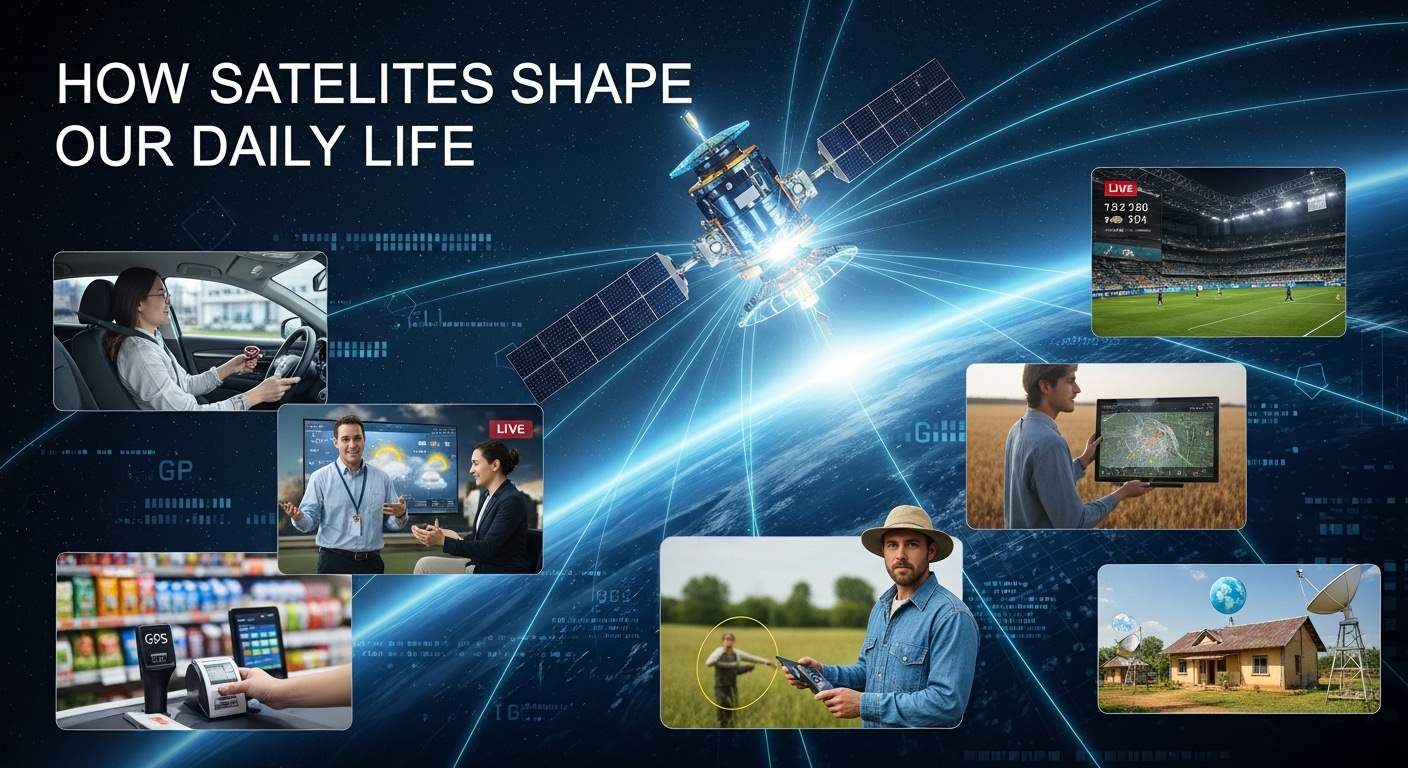
When people think of satellites, they often imagine large spacecraft orbiting far above the Earth, used primarily for space exploration or military purposes. While satellites certainly play critical roles in defense and scientific research, their most profound impact is far more personal and immediate. Satellites are an invisible yet indispensable part of modern life, shaping how we communicate, navigate, work, travel, and even how we eat. Without satellites, the world as we know it today would be unrecognizable.
The story of satellites is one of technological evolution, global cooperation, and daily reliance. From weather forecasting and GPS navigation to banking transactions and television broadcasts, satellites form the backbone of the interconnected world. To appreciate just how deeply they influence our existence, it is worth exploring the history of satellites, their types, their practical applications, and the ways they quietly guide us through every single day.
The Origins of Satellites and Their Evolution
The satellite era began in 1957 when the Soviet Union launched Sputnik 1, the first artificial satellite to orbit the Earth. Though simple in design, Sputnik marked the beginning of a new age of technology and space exploration. What started as a race between superpowers quickly evolved into a field that transformed civilian life.
Early satellites focused on communications and scientific research. Over the decades, advances in miniaturization, computing, and propulsion expanded their roles. Today, thousands of satellites orbit Earth, performing tasks essential to daily life. They range from small CubeSats used for research to massive geostationary satellites that handle communications for entire continents.
This steady evolution has turned satellites from symbols of geopolitical rivalry into vital tools that support commerce, safety, and convenience for billions of people worldwide.
Communication in the Modern Age
One of the most obvious ways satellites shape daily life is through communication. In the early days of global connectivity, satellites were the primary way to transmit television signals and long-distance telephone calls. Even now, they remain indispensable for broadcasting and telecommunications.
Satellite television continues to serve millions of households, particularly in areas where cable infrastructure does not exist. Likewise, satellite phones provide communication lifelines in remote regions, during natural disasters, or at sea. Beyond entertainment and emergencies, satellites underpin internet services. Satellite internet providers offer connectivity to rural or underserved areas, closing gaps where traditional broadband networks cannot reach.
Perhaps more significantly, satellites enable the global synchronization required for cellular networks and digital communications. They carry data across oceans and continents, ensuring that messages, video calls, and live broadcasts can happen instantly. Without them, the seamless communication people take for granted would break down.
Navigation and Location Services
Few technological conveniences are as transformative as satellite navigation. The Global Positioning System, or GPS, launched by the United States, and similar systems such as Europe’s Galileo, Russia’s GLONASS, and China’s BeiDou, provide precise location data worldwide.
GPS has become so deeply embedded in daily life that it is almost invisible. When someone uses a smartphone to find directions, check traffic, or hail a ride, satellites are at work. Airlines, shipping companies, and trucking fleets rely on GPS to optimize routes, saving time, money, and fuel. Farmers use satellite navigation for precision agriculture, ensuring that crops are planted and harvested with maximum efficiency.
Emergency services depend on GPS for locating incidents and dispatching responders quickly. Even everyday activities such as jogging with a fitness tracker or ordering food delivery rely on satellites. The accuracy and ubiquity of satellite navigation illustrate just how critical these systems are to the modern lifestyle.
Weather Forecasting and Climate Monitoring
Every time someone checks the weather before leaving home, satellites are working in the background. Weather satellites orbiting Earth provide real-time data on atmospheric conditions, cloud formations, and storm systems. This information is processed by meteorologists to predict rainfall, snowfall, hurricanes, and other events.
Weather satellites have saved countless lives by enabling early warnings for natural disasters. Hurricanes, typhoons, and tsunamis can now be tracked days before they strike, giving communities time to prepare or evacuate. Beyond immediate forecasting, satellites monitor long-term changes in climate. They measure sea levels, ice thickness, deforestation, and greenhouse gas emissions. These insights are critical for understanding global warming and devising strategies to address it.
Farmers, pilots, sailors, and city planners all rely on satellite-driven weather data. From choosing when to plant crops to deciding whether it is safe to take off in an airplane, satellites play a silent but indispensable role.
Banking and Financial Transactions
It may come as a surprise, but satellites are vital to global finance. Modern banking systems rely on precise timing signals provided by navigation satellites such as GPS. Each satellite carries atomic clocks that synchronize transactions across networks.
When someone swipes a credit card, makes an online purchase, or withdraws money from an ATM, the transaction depends on secure data exchanges that are coordinated by satellites. Stock markets also rely on satellite timing to process millions of trades each second. Without this synchronization, errors and delays would disrupt global economies.
Satellites ensure the security and efficiency of financial systems, proving that they are not just tools of science or communication but pillars of economic stability.
Agriculture and Food Security
Feeding the world’s population is a monumental challenge, and satellites are increasingly central to the solution. Farmers use satellite imagery and data to monitor soil quality, crop health, and water availability. This practice, known as precision agriculture, allows for efficient use of resources and maximizes yields.
Satellites detect changes in vegetation, providing early warnings about pests or diseases. They also help manage irrigation systems by monitoring moisture levels from space. By reducing waste and improving productivity, satellites contribute directly to global food security.
Governments and aid organizations use satellite data to anticipate famines or food shortages, enabling them to respond before crises escalate. Thus, satellites influence not only what we eat but also how food is produced, distributed, and secured worldwide.
Transportation and Safety
Transportation systems around the globe depend on satellites for safety and efficiency. Air traffic controllers rely on satellite navigation to track airplanes and ensure safe flight paths. Ships use satellites for navigation and collision avoidance while crossing oceans. Road transportation benefits from real-time traffic updates and route optimization enabled by GPS.
Public transit systems in many cities use satellite tracking to provide passengers with live arrival updates. Ride-sharing apps depend entirely on satellite navigation to match drivers with riders.
Safety is another critical dimension. Satellites are used for search and rescue operations, enabling authorities to locate stranded hikers, lost sailors, or downed aircraft. The international COSPAS-SARSAT program, for instance, uses satellites to detect distress signals and save lives around the world.
Disaster Management and Humanitarian Aid
When disasters strike, satellites become lifelines. Earth observation satellites provide rapid imagery of affected regions, helping governments and organizations assess damage and coordinate relief efforts. Whether it is an earthquake, flood, wildfire, or hurricane, satellites deliver critical data that saves lives.
For example, during wildfires, satellites track the spread of flames and smoke, allowing firefighters to allocate resources effectively. After earthquakes, they detect ground shifts and structural damage. In floods, satellites monitor rising water levels and guide evacuation plans.
Humanitarian aid also depends on satellites for logistics. Relief agencies use satellite communication to coordinate teams in remote areas where terrestrial networks are destroyed or unavailable. In such contexts, satellites literally bridge the gap between survival and chaos.
Science, Education, and Research
Satellites not only serve practical purposes but also expand human knowledge. Scientific satellites study Earth’s magnetic field, track animal migration, and monitor environmental changes. Others venture deeper into space, sending back data that enriches our understanding of the universe.
For education, satellites enable distance learning. Students in remote regions can access online classes via satellite internet. Television broadcasts via satellite have long been used to deliver educational content to communities without access to schools or teachers.
Satellites also foster international cooperation. Programs such as weather monitoring and disaster response often involve data sharing between nations, highlighting the role of satellites in promoting global solidarity.
Entertainment and Cultural Exchange
Beyond utility and science, satellites also shape leisure and culture. Satellite broadcasting delivers live sports, news, and entertainment across the globe. Major events such as the Olympics, World Cup, or international concerts are transmitted in real time thanks to satellites.
Cultural exchange has flourished because of satellite television. People in one part of the world can watch films, music, and documentaries from another, promoting cross-cultural understanding. Even the streaming platforms that dominate entertainment today often rely on satellite connectivity for data transmission in certain regions.
This global reach of entertainment, powered by satellites, has helped make the world feel smaller and more connected.
Military and National Security
While the focus here is on civilian life, it is impossible to ignore the role of satellites in national security. Many technologies developed for defense later find applications in daily life. For example, GPS began as a military project before being opened to the public. Military satellites provide surveillance, reconnaissance, and communication capabilities that indirectly protect civilian populations.
The secure environment created by these technologies allows societies to function and economies to thrive. Thus, even when satellites serve defense purposes, they indirectly shape the daily lives of billions.
The Future of Satellites in Daily Life
Satellites will only become more important in the future. Emerging technologies such as low-Earth orbit satellite constellations promise to deliver high-speed internet across the globe, closing the digital divide. Companies are launching thousands of small satellites to provide connectivity even in the most remote corners of the planet.
In healthcare, satellites will enable telemedicine services, connecting patients with doctors regardless of location. In environmental protection, satellites will provide more precise data on carbon emissions, helping humanity combat climate change. In transportation, satellites will support autonomous vehicles and drones, making them safer and more efficient.
The future will likely see satellites embedded even deeper into the fabric of everyday life, driving progress while raising new questions about sustainability, space debris, and international cooperation.
Conclusion
Satellites may orbit silently above the Earth, but their influence resonates in every aspect of modern life. They connect us through communication, guide us through navigation, warn us of storms, secure our financial systems, and even put food on our tables. They protect us during disasters, entertain us during leisure, and expand our understanding of both our planet and the universe.
The history of satellites is a story of human ingenuity and collaboration, but their present role is one of quiet indispensability. Satellites shape daily life so profoundly that their absence would plunge the world into chaos. Yet because they operate silently in the background, most people hardly notice them.
By recognizing the ways satellites shape our existence, society can better appreciate their value, support their sustainable use, and prepare for a future where these orbiting tools continue to bridge gaps, protect lives, and connect the world in ways once thought impossible.