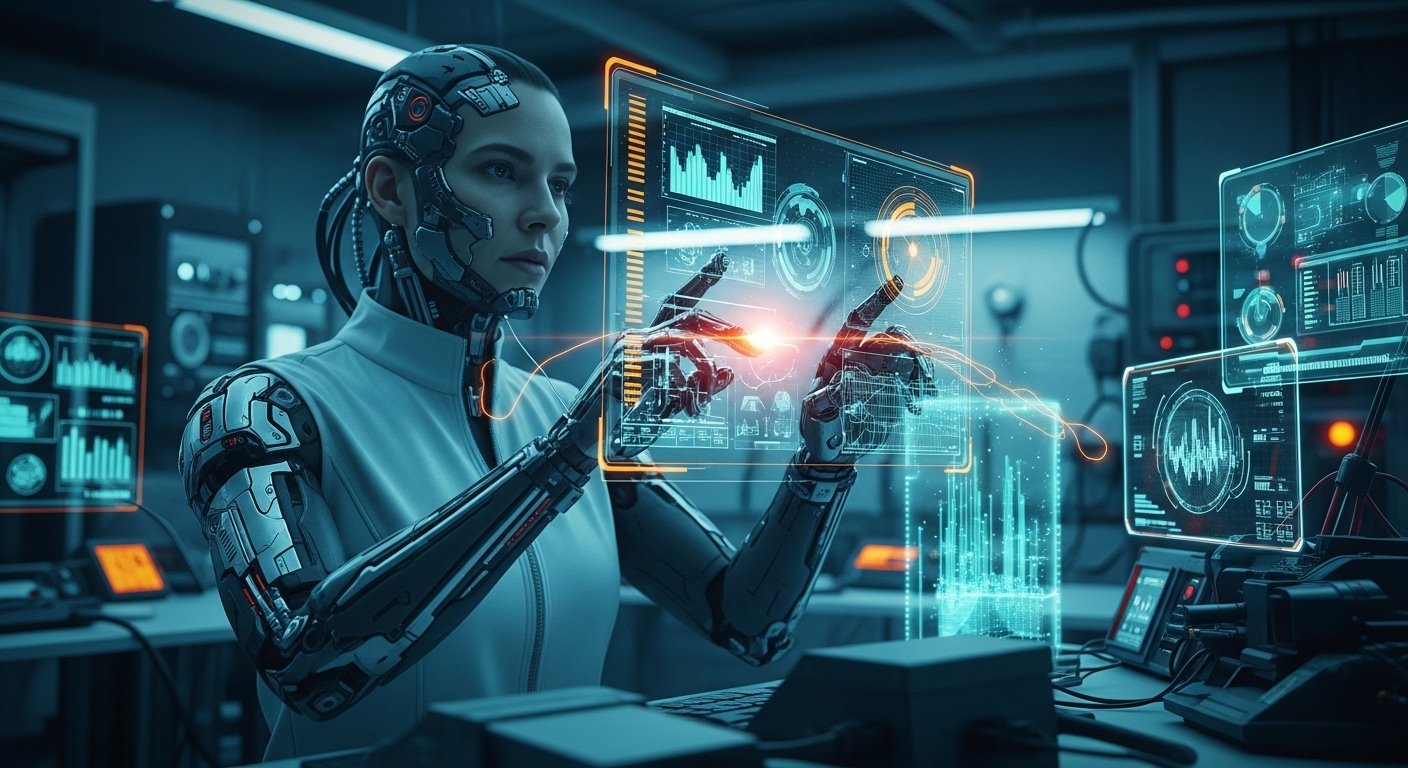





Technology has always been at the heart of human progress. From the first wheel to the latest artificial intelligence systems, each new advancement has reshaped the way we live, work, and communicate. Today, we stand on the brink of yet another technological revolution, where emerging trends promise to alter industries, redefine lifestyles, and solve some of the world’s most complex challenges. In this blog post, we will explore the key tech trends shaping the future and how they might impact every facet of our lives.
The Unstoppable Rise of Artificial Intelligence
Artificial Intelligence (AI) has moved from the realm of science fiction into everyday reality. It’s no longer just a tool for research labs or large corporations but a driving force in industries ranging from healthcare to finance, entertainment, and even customer service. The ability of AI to process vast amounts of data and make decisions at lightning speed has revolutionized how we approach problem-solving.
Machine learning, a subset of AI, allows systems to “learn” from data and improve over time. In healthcare, AI algorithms help doctors diagnose diseases more accurately by analyzing medical images or patient histories. In finance, AI models predict market trends and assist in fraud detection. And in customer service, AI-driven chatbots are becoming the norm, offering quick and efficient solutions to everyday inquiries.
What’s next for AI? As the technology continues to evolve, we can expect it to become even more integrated into our daily lives, offering personalized experiences, smarter virtual assistants, and more efficient business operations. However, as AI becomes more capable, ethical questions around privacy, bias, and job displacement will need to be addressed.
Quantum Computing: The Frontier of Unsolvable Problems
While AI has made significant progress, quantum computing is still in its infancy but holds the potential to revolutionize many fields. Quantum computing is based on the principles of quantum mechanics, which allow quantum bits, or qubits, to exist in multiple states simultaneously. This unique characteristic enables quantum computers to solve complex problems at an exponential rate compared to classical computers.
While today’s most advanced quantum computers are still limited by technical challenges, their potential is vast. Quantum computing could revolutionize areas like drug discovery, materials science, and cryptography. For example, quantum simulations could lead to new breakthroughs in designing better medicines or sustainable materials. It could also crack previously unsolvable encryption codes, creating both opportunities and challenges in the cybersecurity realm.
As quantum computing matures, it may open up new avenues for scientific discovery and problem-solving, but its practical applications are still several years away. However, the research and progress being made today will lay the groundwork for tomorrow’s breakthroughs.
5G and Beyond: A New Era of Connectivity
5G, the fifth generation of wireless network technology, is poised to change the way we connect to the internet. With download speeds up to 100 times faster than 4G and ultra-low latency, 5G promises to unlock a new era of connectivity that will enable technologies such as autonomous vehicles, smart cities, and augmented reality (AR) to thrive.
The key benefit of 5G is its ability to handle more data and more devices simultaneously, making it ideal for the Internet of Things (IoT). Imagine a world where every device you own is connected in real-time: from refrigerators that order groceries to smart cities with intelligent traffic systems that reduce congestion. Autonomous vehicles will benefit from the ultra-low latency of 5G, allowing them to communicate with each other and with infrastructure in real time to avoid accidents and optimize traffic flow.
While the rollout of 5G networks is still in progress, the potential impact on industries like healthcare, entertainment, and manufacturing is profound. Telemedicine will become more effective with high-quality, real-time video consultations. AR and VR experiences will become more immersive, as 5G provides the necessary bandwidth for seamless, high-quality experiences. The world will become more connected, efficient, and responsive than ever before.
Blockchain and the Future of Trust
Blockchain, most commonly associated with cryptocurrencies like Bitcoin and Ethereum, is much more than a digital ledger for financial transactions. Blockchain technology is decentralized, secure, and transparent, making it ideal for applications that require trust without intermediaries.
Blockchain could revolutionize supply chain management by providing real-time, tamper-proof tracking of goods from production to delivery. In healthcare, blockchain could store patient data securely and allow for seamless sharing between hospitals and clinics, ensuring that medical histories are both accurate and accessible. In the realm of voting, blockchain could help prevent fraud and increase voter turnout by providing secure, verifiable records of ballots.
One of the most promising applications of blockchain technology is the rise of smart contracts. These self-executing contracts automatically enforce terms when predefined conditions are met, reducing the need for intermediaries and increasing trust in business transactions. While blockchain technology is still evolving, its potential to disrupt industries and change how we think about security and trust is undeniable.
Augmented and Virtual Reality: Blurring the Lines Between the Real and the Digital
Augmented Reality (AR) and Virtual Reality (VR) are technologies that have the potential to transform entertainment, education, and even business. While both involve immersing users in digital environments, they differ in how they interact with the real world.
Augmented reality overlays digital content onto the physical world, enhancing what we see, hear, and interact with. Popularized by mobile games like Pokémon Go, AR is now making waves in retail and healthcare. In retail, AR apps let users virtually try on clothes or visualize how furniture looks in their home. In healthcare, AR is being used to assist surgeons by providing real-time, 3D visualizations of organs or muscles during operations.
Virtual reality, on the other hand, immerses users in completely digital worlds. While VR has been most commonly used in gaming and entertainment, its applications are expanding into education, training, and even therapy. VR is being used to simulate real-world scenarios for medical students, train pilots, and help patients overcome phobias or anxiety through exposure therapy.
The potential of both AR and VR is vast, and as these technologies continue to evolve, they will transform the way we interact with information, entertainment, and even each other.
The Sustainability Movement: Green Tech Innovations for a Better Tomorrow
As the world grapples with climate change, sustainable technology (also known as “green tech”) is becoming increasingly important. Innovations in renewable energy, waste management, and energy efficiency are helping to reduce carbon footprints and promote environmental sustainability.
Solar and wind power continue to grow as alternatives to fossil fuels, with significant advancements in battery storage and energy grid management making renewable energy more viable. Electric vehicles (EVs) are also gaining traction, thanks to improved battery technologies and expanding charging infrastructure.
In addition to clean energy, green tech innovations are transforming industries like agriculture. Precision farming, powered by IoT and AI, allows farmers to optimize water use, reduce pesticide usage, and increase crop yields. Startups are also developing technologies to turn waste into valuable resources, from turning plastic waste into sustainable construction materials to using algae for biofuel production.
As the world continues to face environmental challenges, the rise of green tech will play a pivotal role in ensuring a more sustainable and resilient future.
Conclusion: Embracing the Tech-Driven Future
Technology is moving faster than ever, and the trends shaping the future are both exciting and transformative. From artificial intelligence and quantum computing to blockchain, 5G, and immersive realities, these innovations are poised to revolutionize how we live, work, and solve global challenges.
While many of these technologies are still in the early stages, the possibilities they hold for industries, society, and even our daily lives are boundless. As we continue to embrace these advancements, we must also consider the ethical, social, and environmental implications of technology.
One thing is clear: the future is tech-driven, and we are on the verge of a new era of innovation that promises to reshape the world in ways we can only begin to imagine. The key to navigating this future will be to harness the power of these technologies in ways that benefit humanity as a whole, creating a future that is not only smarter but also more connected, sustainable, and inclusive.