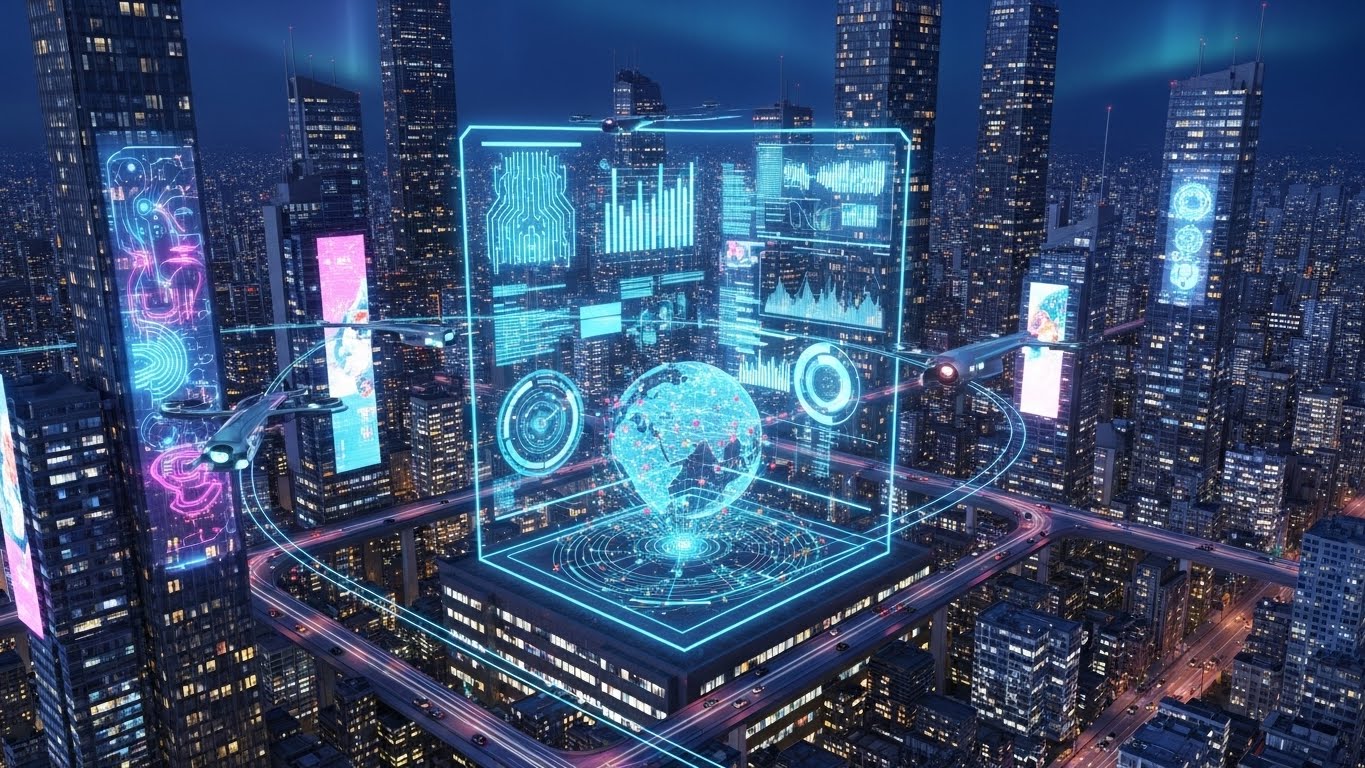





Artificial Intelligence (AI) has been one of the most transformative forces in the technology world. Over the past decade, we’ve witnessed AI evolve from a speculative concept into a practical tool that shapes everything from self-driving cars to healthcare diagnostics, and even entertainment. But as we look to the future, the potential of AI becomes even more profound. What’s ahead? Will AI continue its rapid evolution, or are we approaching a plateau? This blog post will explore the future of AI, focusing on the impacts it will have across various industries, the opportunities it will create, and the challenges it will bring.
The Current State of Artificial Intelligence
Before diving into the future, it’s essential to understand where AI stands today. AI can be broadly categorized into two types: Narrow AI and General AI.
- Narrow AI: This type of AI is designed to perform specific tasks. Common examples include voice assistants like Siri, recommendation algorithms on Netflix, and even facial recognition technology. Narrow AI has made significant strides and is a part of our everyday lives.
- General AI: This is the holy grail of artificial intelligence—an AI that can perform any intellectual task that a human being can. While General AI remains a theoretical concept, researchers and companies continue to work toward making it a reality. Some experts predict that achieving General AI could take decades, while others are more optimistic, suggesting it could happen within the next few years.
The Evolution of AI: A Glimpse into the Future
The next wave of AI will be defined by advancements in machine learning, deep learning, and reinforcement learning. These technologies will give rise to AI systems that are capable of even more complex and human-like decision-making. So, what does the future hold for AI?
1. AI in Healthcare: Revolutionizing Medicine
One of the most promising areas where AI is poised to make a substantial impact is in healthcare. Over the next few years, AI-powered technologies could dramatically reshape the way healthcare is delivered.
Precision Medicine
AI will allow for the development of precision medicine, which tailors treatment plans to individual patients based on their genetic makeup, lifestyle, and environment. By analyzing vast amounts of data, AI can help doctors identify the most effective treatments for specific patients, reducing the trial-and-error process that often characterizes traditional healthcare.
Diagnostic AI
AI’s ability to analyze medical data far exceeds human capabilities in many cases. In the future, AI could be used for real-time diagnostics. For example, AI-driven systems could analyze medical images like X-rays, MRIs, and CT scans more accurately than human doctors. With deep learning, AI can identify patterns and detect diseases like cancer, diabetes, and heart disease in their early stages, often with greater precision than human practitioners.
AI in Drug Discovery
Another exciting development is the use of AI in drug discovery. Traditional drug development is a time-consuming and expensive process. However, AI can help predict the molecular properties of potential drugs, speeding up the discovery phase and making it more cost-effective. AI-powered simulations could even predict side effects and interactions before clinical trials begin.
2. AI in Autonomous Systems: Self-Driving Cars and Beyond
The realm of autonomous vehicles has attracted significant attention in recent years, and it’s clear that AI will be the backbone of this technological revolution. While fully autonomous cars are still in development, the future looks promising.
The Road to Fully Autonomous Vehicles
In the future, self-driving cars powered by AI could become the norm on roads. These cars will be capable of making decisions in real-time, processing data from sensors, cameras, and other sources to navigate safely. AI will help vehicles understand their surroundings, anticipate potential hazards, and make complex decisions like lane changes and obstacle avoidance without human intervention.
AI in Drones and Robotics
AI isn’t limited to self-driving cars. Drones and robots are expected to become more autonomous and intelligent in the near future. AI-powered drones could be used for delivery services, surveillance, agriculture, and even disaster response. Similarly, robots equipped with AI could perform tasks in warehouses, homes, and hospitals, assisting with everything from logistics to caregiving.
3. AI in Business: Transforming Industries
AI’s influence isn’t just limited to healthcare and transportation. Many industries are beginning to harness the power of AI to improve efficiency, reduce costs, and enhance customer experience.
AI in Customer Service
One of the most visible applications of AI in business is in customer service. Chatbots and virtual assistants powered by AI can provide round-the-clock support, answering common customer queries, resolving issues, and even personalizing interactions based on the customer’s history and preferences. This automation not only saves time for human employees but also provides faster and more consistent service for customers.
AI in Marketing and Sales
Marketing and sales are also being transformed by AI. Predictive analytics tools powered by AI can help companies understand consumer behavior and predict trends with a high degree of accuracy. AI-driven tools can also personalize advertisements, making them more relevant to individual users, increasing the chances of conversion. Additionally, AI can be used to optimize pricing strategies by analyzing market data and competitor prices in real-time.
AI for Decision-Making
Business leaders will increasingly rely on AI to make data-driven decisions. AI’s ability to analyze vast amounts of data and provide insights will be invaluable for executives in industries ranging from finance to retail. In finance, for example, AI algorithms can predict market trends and assist with investment strategies. In retail, AI can predict demand, optimize inventory management, and streamline supply chains.
4. AI and the Workforce: Automation and Employment
The rise of AI will undoubtedly lead to job automation in many industries. This raises the question: how will AI impact the global workforce?
Job Displacement vs. Job Creation
While AI is likely to displace certain jobs, particularly those involving routine tasks like data entry or basic customer service, it will also create new jobs in fields that don’t yet exist. For instance, there will be a demand for AI specialists, data scientists, and ethical AI officers—positions that require a deep understanding of how AI works and how it can be deployed safely and ethically.
Reskilling and Upskilling the Workforce
To prepare for this transformation, there will be a growing need for reskilling and upskilling programs. Workers will need to acquire new skills, particularly in technology and data analysis, to remain relevant in the AI-driven job market. Governments, companies, and educational institutions will need to collaborate to provide workers with the tools they need to succeed.
5. Ethical Implications: The Dark Side of AI
As powerful as AI is, its rapid development presents numerous ethical dilemmas. Issues like bias in AI, data privacy, and the use of AI in surveillance will need to be addressed carefully.
AI Bias and Fairness
AI systems are only as good as the data they are trained on. If an AI model is trained on biased data, it can perpetuate or even exacerbate existing social biases. For instance, facial recognition algorithms have been shown to perform poorly on people of color, leading to false identifications. It is crucial that AI developers prioritize fairness and inclusivity when designing algorithms to avoid reinforcing harmful biases.
Privacy Concerns
AI systems rely heavily on data, and much of that data is personal. From healthcare data to online shopping behavior, AI can learn a great deal about individuals. However, this raises concerns about privacy and data security. Governments and tech companies will need to work together to create strong data protection laws and frameworks to ensure that personal data is not misused.
AI in Surveillance
Another ethical issue is the use of AI in surveillance. Governments and corporations are increasingly using AI-powered facial recognition and tracking systems for security purposes. While these systems can be useful for identifying criminals or preventing terrorist attacks, they also raise concerns about mass surveillance and the erosion of privacy. Striking the right balance between security and civil liberties will be one of the key challenges in the coming years.
The Opportunities and Benefits of AI
The future of AI presents numerous opportunities that could dramatically improve our lives. Some of the most exciting benefits include:
- Improved Quality of Life: AI-powered healthcare, education, and personal assistants can improve accessibility and provide better services for people around the world.
- Increased Efficiency: Automation will make industries more efficient by reducing manual labor, speeding up processes, and reducing human error.
- Economic Growth: AI has the potential to drive significant economic growth by creating new industries and enhancing existing ones. Sectors like finance, manufacturing, and agriculture stand to benefit from AI’s ability to optimize processes and improve outcomes.
- Global Challenges: AI can play a pivotal role in solving some of the world’s most pressing challenges, such as climate change, poverty, and disease. For instance, AI can be used to develop sustainable energy solutions, predict and mitigate natural disasters, and accelerate medical research.
Conclusion: Navigating the Future of AI
Artificial Intelligence is at a crossroads. While it holds incredible promise, it also poses significant risks. The future of AI will depend on how we, as a society, choose to shape its development. As we move forward, it’s crucial that we balance innovation with caution, ensuring that AI benefits humanity while mitigating potential harm.
Governments, tech companies, and the global community must work together to create ethical frameworks, promote inclusivity, and prepare the workforce for the changes AI will bring. The future of AI is not just a technological challenge—it’s a societal one. The choices we make today will determine how AI impacts the world tomorrow.